Panagiotis Peikidis
I am a polyglot software developer and technical consultant based in New York, USA.
'%3e%3cpath%20d='M15,3c-6.627,0%20-12,5.373%20-12,12c0,5.623%203.872,10.328%209.092,11.63c-0.056,-0.162%20-0.092,-0.35%20-0.092,-0.583v-2.051c-0.487,0%20-1.303,0%20-1.508,0c-0.821,0%20-1.551,-0.353%20-1.905,-1.009c-0.393,-0.729%20-0.461,-1.844%20-1.435,-2.526c-0.289,-0.227%20-0.069,-0.486%200.264,-0.451c0.615,0.174%201.125,0.596%201.605,1.222c0.478,0.627%200.703,0.769%201.596,0.769c0.433,0%201.081,-0.025%201.691,-0.121c0.328,-0.833%200.895,-1.6%201.588,-1.962c-3.996,-0.411%20-5.903,-2.399%20-5.903,-5.098c0,-1.162%200.495,-2.286%201.336,-3.233c-0.276,-0.94%20-0.623,-2.857%200.106,-3.587c1.798,0%202.885,1.166%203.146,1.481c0.896,-0.307%201.88,-0.481%202.914,-0.481c1.036,0%202.024,0.174%202.922,0.483c0.258,-0.313%201.346,-1.483%203.148,-1.483c0.732,0.731%200.381,2.656%200.102,3.594c0.836,0.945%201.328,2.066%201.328,3.226c0,2.697%20-1.904,4.684%20-5.894,5.097c1.098,0.573%201.899,2.183%201.899,3.396v2.734c0,0.104%20-0.023,0.179%20-0.035,0.268c4.676,-1.639%208.035,-6.079%208.035,-11.315c0,-6.627%20-5.373,-12%20-12,-12z'%3e%3c/path%3e%3c/g%3e%3c/g%3e%3c/svg%3e)
'%3e%3cpath%20d='M4.60588%209.45456H4.12103C3.20679%209.45456%202.74968%209.45456%202.46566%209.74425C2.18164%2010.034%202.18164%2010.5002%202.18164%2011.4327V19.84C2.18164%2020.7725%202.18164%2021.2388%202.46566%2021.5285C2.74968%2021.8182%203.20679%2021.8182%204.12103%2021.8182H4.60588C5.52012%2021.8182%205.97724%2021.8182%206.26126%2021.5285C6.54528%2021.2388%206.54528%2020.7725%206.54528%2019.84V11.4327C6.54528%2010.5002%206.54528%2010.034%206.26126%209.74425C5.97724%209.45456%205.52012%209.45456%204.60588%209.45456Z'%20stroke='white'%20stroke-width='1.5'/%3e%3cpath%20opacity='0.4'%20d='M6.54528%204.36364C6.54528%205.56863%205.56844%206.54546%204.36346%206.54546C3.15847%206.54546%202.18164%205.56863%202.18164%204.36364C2.18164%203.15866%203.15847%202.18182%204.36346%202.18182C5.56844%202.18182%206.54528%203.15866%206.54528%204.36364Z'%20stroke='white'%20stroke-width='2'/%3e%3cpath%20d='M12.2493%209.45456H11.4323C10.4998%209.45456%2010.0335%209.45456%209.74379%209.74425C9.4541%2010.034%209.4541%2010.5002%209.4541%2011.4327V19.84C9.4541%2020.7725%209.4541%2021.2388%209.74379%2021.5285C10.0335%2021.8182%2010.4998%2021.8182%2011.4323%2021.8182H11.9268C12.8593%2021.8182%2013.3256%2021.8182%2013.6153%2021.5285C13.905%2021.2388%2013.905%2020.7725%2013.905%2019.84L13.9051%2016.3783C13.9051%2014.7396%2014.4273%2013.411%2015.9701%2013.411C16.7414%2013.411%2017.3668%2014.0753%2017.3668%2014.8947V19.3456C17.3668%2020.2781%2017.3668%2020.7443%2017.6565%2021.034C17.9461%2021.3237%2018.4124%2021.3237%2019.3449%2021.3237H19.8382C20.7705%2021.3237%2021.2367%2021.3237%2021.5264%2021.0341C21.8161%2020.7445%2021.8162%2020.2784%2021.8164%2019.3461L21.8177%2013.9057C21.8177%2011.4476%2019.4798%209.4548%2017.1658%209.4548C15.8484%209.4548%2014.6732%2010.1005%2013.9051%2011.1103C13.905%2010.4871%2013.905%2010.1755%2013.7697%209.94416C13.6839%209.79764%2013.5619%209.67565%2013.4154%209.58994C13.184%209.45456%2012.8725%209.45456%2012.2493%209.45456Z'%20stroke='white'%20stroke-width='1.5'%20stroke-linejoin='round'/%3e%3c/g%3e%3cdefs%3e%3cclipPath%20id='clip0_8679_11877'%3e%3crect%20width='24'%20height='24'%20fill='white'/%3e%3c/clipPath%3e%3c/defs%3e%3c/svg%3e)

© 2026 pekalicious. All Rights Reserved.
USA Character Cards
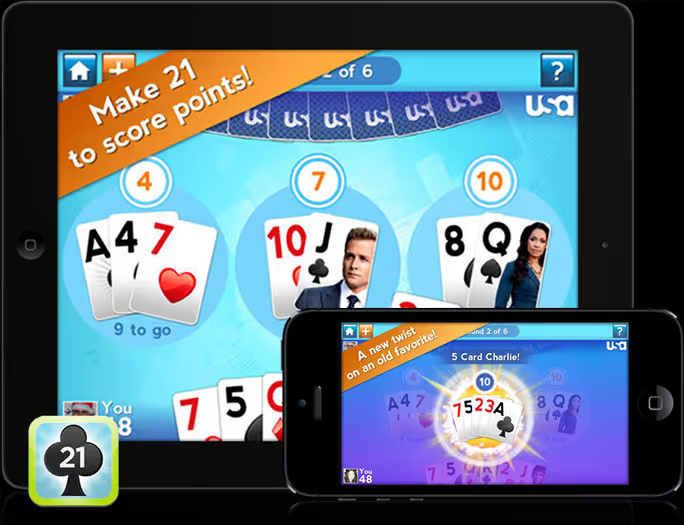
USA Character Cards was a mobile card game built in partnership with USA Network and themed around characters from its television properties. Players competed head-to-head to outscore their opponent, earn rewards, and unlock show-themed skins for their decks.
I was the sole engineer on the project from prototype through release, delivering the game in roughly 6 to 8 months with a small team of one engineer, one designer, one artist, and one product owner. That made the role much broader than pure implementation: I owned the technical architecture, coordinated directly with the product owner, defined team workflows, and put the deployment process in place so the project could move quickly without becoming brittle.
Leadership and Ownership
As lead engineer, I was responsible for the full technical direction of the project. I defined how the client and server responsibilities were split, established the team’s delivery workflow, and made engineering decisions that let a very small team prototype quickly while still building toward a shippable product.
Because there was no second engineer to absorb infrastructure or tooling work, I also took ownership of the development process itself. That included deployment planning, build automation, source control practices, and the integration workflow between code, design, and art.
Client Architecture and Gameplay Validation
The primary implementation was on the Unity3D client in C#. I built the gameplay-facing systems and designed the core game logic so that the gameplay engine could run as a standalone library outside the Unity runtime. This allowed the same logic to be used to verify valid moves independently of the client, which improved confidence in gameplay correctness and reduced the risk of client-side inconsistencies.
That architecture was especially useful on a competitive card game, where rules validation and predictable behavior matter more than in a purely local single-player experience. It also created a cleaner separation between presentation and rules logic, which made the project easier to maintain as the prototype evolved into a released product.
Workflow, Tools, and Team Efficiency
In addition to game implementation, I worked on the art integration workflow and designer-facing tools so the non-engineering side of the team could iterate without unnecessary friction. On a team this small, development speed depends heavily on reducing handoff cost, so part of my role was making sure design and art changes could move through the project reliably.
I also built the first Jenkins-based CI/CD pipeline used at the company for this project. Before that, builds were typically created manually on a developer machine. I configured a dedicated build machine and automated the process, which saved significant engineering time, reduced interruption to day-to-day development, and made builds more repeatable. That approach later became the basis for broader adoption across the company.
At the same time, I pushed the transition from SVN to Git while many projects were still on the older workflow. That gave the team a stronger foundation for branching, iteration, and release management, and it aligned the project with a more scalable engineering process.
Server and Release Process
While most of my work was client-side, I also contributed to server-side systems built with PHP and MySQL. On the delivery side, I defined and supported the deployment process using Jenkins and TestFlight, which helped the team move from rapid prototype iteration to a stable mobile release workflow.
The end result was a shipped product on both app stores, delivered under a compressed schedule with a very small team. From a portfolio perspective, the project is a strong example of end-to-end engineering leadership: architecture, gameplay systems, tooling, build automation, process definition, and release ownership all sat with me on a commercial partner-backed title.